36th Chamber · Section 1
Zen Quantum Human
Source pages 7 to 10
This poem functions less like a linear poem and more like a conceptual map. It reads as a field of correspondences - a constellation, a mandala, a training hall - where meaning arises from proximity, tension, and resonance rather than syntax or narrative.
In this way, I am not telling the reader something; I am placing them inside a system.
Structure & Form
Columnar / Grid Logic
The spacing and alignment matter as much as the words themselves. The poem behaves like a diagram or whiteboard of thought. Vertical stacks imply equivalence. Horizontal movement implies translation or bridging; interdependence, a unified-field.
This mirrors: Zen koan logic. Scientific mapping. Martial arts training charts. Neural or conceptual networks. The form embodies the theme of entanglement. E=MC²
Thematic Observations
Zen·Human·Quantum
This opening triad establishes the core tension:
Zen → direct experience, emptiness, non-duality
Human → embodied, emotional, flawed, relational
Quantum → non-locality, paradox, observer effect
Placed side-by-side, none is privileged. The poem refuses hierarchy.
Map·Guide·Practice
This is crucial to distinguish:
Map (representation, conceptual). A map without practice is theoretical abstraction.
Guide (direction, relational). A guide without a map is wandering without direction.
Practice (embodied). Practice without a guide is walking in the dark without a light.
This subtly critiques purely intellectual spirituality or science. This poem and book-blog repeatedly draw the reader back to integrating theory into embodied practice. CQ²
Philosophy·Science·FEEEEEL
The stretched spelling is not decorative. It slows the reader down. It embodies flow state. It resists reduction into a concept. This is the poem’s first somatic interruption; feeling breaks the clean symmetry. As Bruce Lee says, “Don’t think. FEEEEEL!”
Poetry·Mysticism·Entangled
Here, language itself becomes a quantum object:
Poetry ≠ explanation
Mysticism ≠ belief
Entanglement ≠ metaphor only
Meaning here is relational, not contained.
Movement & Embodiment
Yoga·Tai Chi·Meditation
Boxing·Chi Gong·Movement
This pairing is deliberate and important.
Internal / external
Soft / hard
Stillness / impact
By placing boxing alongside internal arts, this collapses false spiritual hierarchies. Awareness is not passive; it moves, strikes, responds. Balance yin-yang opposites. In this way, return home to your true nature, whole-being, inter-be. I AM USYK FEEL.
Yin·Yang·Rhythm
This is the most traditional triad in the poem - notice: it is earned by everything before it. Rhythm is not static; it is the result of movement, contrast, and tension; Tao.1
I am born a Chinese fraternal twin; as twin-opposites - we live yin-and-yang - and the Chang twins be like Oliver and Hardy, Sherlock-y and Holmes and any other counterbalancing double-act like Shiva-and-Shakti in divine union; the cosmic dance.
Identity & Absence
Mixed·Internal Arts·M.I.A²
action·‘I’ missing·in·CQ²
“Mixed” destabilizes purity. “Internal Arts” implies unseen work; purification of the mind and five senses, the internal path to the self. ‘I’ missing is both playful and profound; balance discipline-and-surrender, and at the still-point, embody flow state. Who Am I?
The self is: Not erased. Not centered. Functionally absent. Action happens without egoic fixation; awareness-of-awareness-itself. Meta-cognition.
Consciousness & Lineage
Neurons·Mirror·Masters
Consciousness Quotient·Squared
A bridge: Neuroscience (biological substrate, mirror neurons, empathetic circuitry) Transmission (embody masters) Measurement (quotient) self-reflexive awareness.
“Squared” suggests: Intensification - Recursion - Self-reflection - awareness reflecting upon itself - awareness-of-awareness-itself.
Empty your mind. Be formless, shapeless, like water. You put water into a cup, it becomes the cup. You put water into a bottle, it becomes the bottle. You put it in a teapot, it becomes the teapot. Now, water can flow, or it can crash. Be water, my friend.
In Enter the Dragons climactic end scene - Bruce Lee enters a Hall-of-Mirror-to-the-Self - and the only enemy is the enemy within. Who Am I? TAT TVAM ASI. I AM.
Lee Jun-fan·I AM USYKFEEL·
Ending with Bruce Lee’s given name grounds everything. He represents synthesis; practice over doctrine, expression over style; Know Thyself, be limitless. Explore the entire bandwidth of yin-and-yang - counterbalance-the-opposites - CQ²
“I AM USYKFEEL”:
A meme mantra. A glitch. An embodied declaration. The poem ends not with explanation - with invitation. This poem acts as a threshold text, a training map, a philosophical koan.
It does not ask to be understood. It asks to be returned; practiced, explored, inhabited, embodied. Be water, my friend.
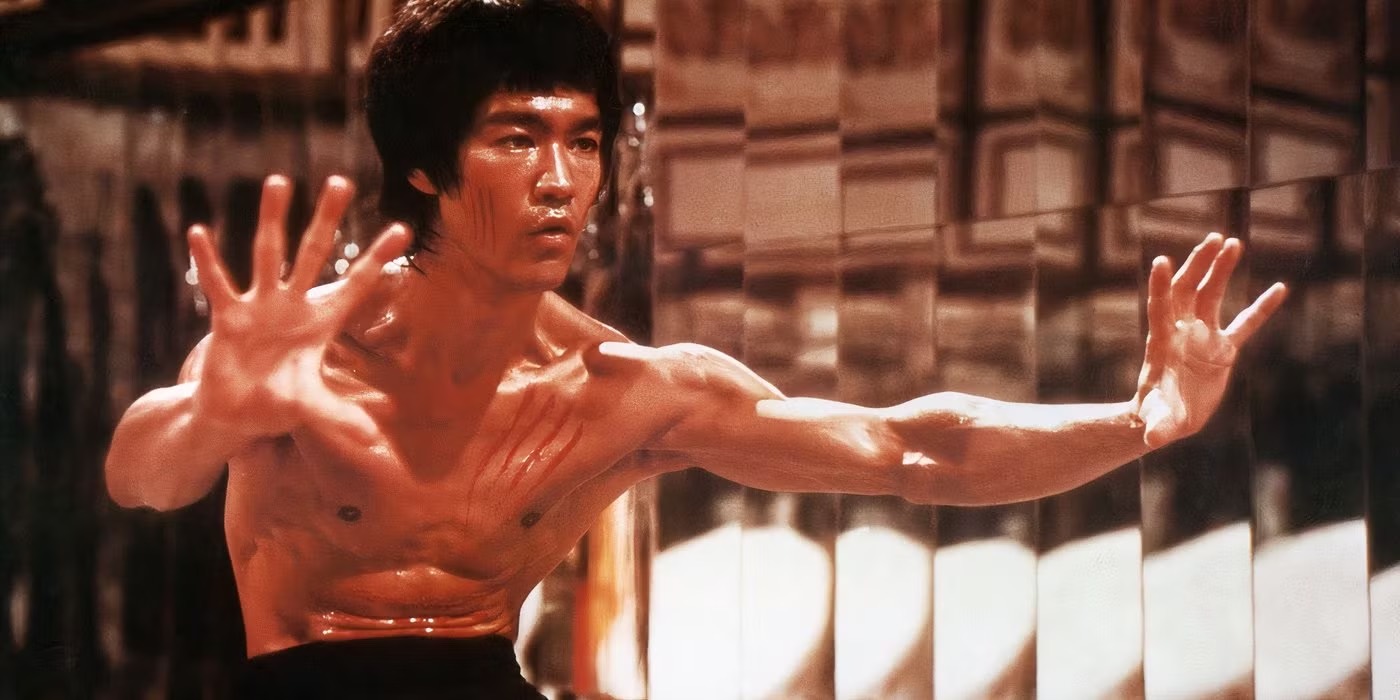
Bruce Lee and Oleksandr Usyk appear as exemplars of Quantum Human. Each embodies the collapse of false dualities - mind and body, softness and force, thought and action - into a single, responsive field of awareness. Bruce Lee represents the original synthesis, the O. G. Quantum Human pioneer: his insistence on “no fixed style,” direct feeling over conceptualization, and action without ego mirrors quantum superposition, where form remains fluid until the precise moment of expression; he trains the nervous system to respond before the intellect interferes, making awareness functional rather than abstract. You must be shapeless, formless like water.
Usyk extends this lineage in a contemporary register: his movement, timing, and composure under pressure demonstrate coherence across breath, perception, ring generalship - a masterful chess boxing IQ - power arises from relaxation, centredness and presence rather than brute force; like Lee, he operates as a unified system where intelligence is distributed through the whole body, not centralized in thought. This, the art of the sweet science. No one but me gets into my head...I am feel. I am very feel.
Together they embody Quantum Human as one who lives in dynamic balance - yin yielding to yang and back again - where discipline refines spontaneity; mastery is revealed as emptiness that can adapt instantly to what is present, moment-by-moment.
I absolutely do not divide people into any religions, creeds, political views. Usyk.